
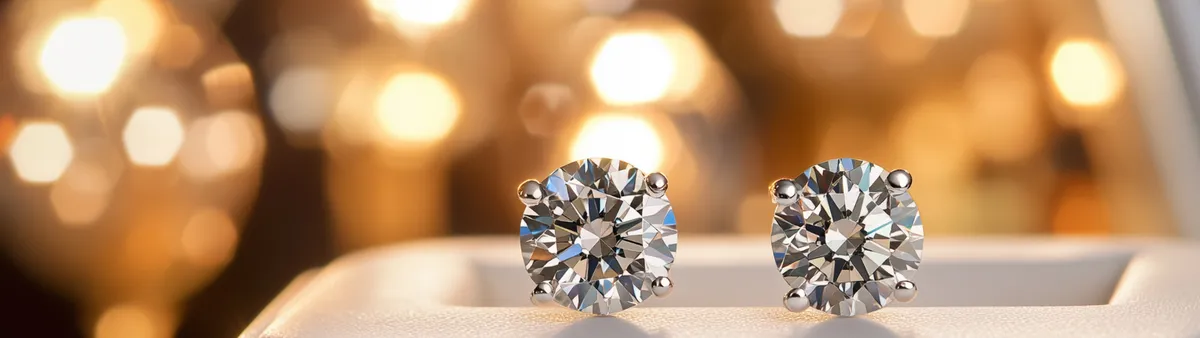
Shopping for diamond stud earrings can feel like ordering at a restaurant with a 20-page menu. Everything looks good, and you’re not sure where to start.
So let Dahlkemper's Jewelry Connection make it simple. Instead of memorizing jewelry jargon, we’ll ask you seven questions. Each answer will help narrow down your choices. By the end, you’ll know how to pick diamond studs that fit your style, budget, and life. Think of this as a diamond stud earrings buying guide that does the sorting for you!
Question 1: What’s Your Budget?
This is the best starting point, because all your other answers will depend on this. According to the Gemological Institute of America (GIA), diamond stud earrings can range anywhere from about $100 to over $30,000.
How much you’ll pay for your studs will largely be determined by the diamond 4Cs: carat, cut, color, and clarity. And since you’re buying two diamonds, you will need two stones that are similar in terms of these factors. The good news is that studs give you more wiggle room than an engagement ring does.
Here’s how each of the 4Cs of diamonds affects a diamond’s value:
- Carat weight: Bigger diamonds, higher prices. Price per carat climbs as diamonds grow. So a stone twice as heavy can cost twice as much—if not more.
- Cut: Better-cut diamonds, higher prices. An Excellent cut costs more, but it’s worth the brilliance of the diamond. You could spend much less on a poorly cut diamond, but it will be noticeably dull regardless of its size. A Very Good cut is a good middle ground.
- Color: Whiter diamonds, higher prices. Colorless grades (D to F) carry a premium price tag. Near-colorless grades (G to J) have a hint of yellow, but they still appear quite white and cost less. Diamonds also reflect the metal, skin, and hair around them, so small color differences are hard to spot on your ears.
- Clarity: Less-flawed diamonds, higher prices. Flawless diamonds, those with no inclusions, are rare and expensive. Very Slightly Included (VS) to Slightly Included (SI) are good options for those who want to save money and still get a stone that looks clean to the naked eye. Very low-grade diamonds (I3) are the cheapest but can look cloudy.
Think about which factors matter most to you and which ones you’re willing to compromise on. For example, you can go lower on color and clarity if you prefer bigger and better-cut diamonds.
YOUR ANSWER: Determine a specific price range you’re comfortable with before buying diamond stud earrings. It keeps the fun of shopping from turning into regret.
Question 2: How Big Do You Like Them?
Size is the first thing people notice in a pair of diamond studs, so consider how big you want your gems to be. Keep in mind that studs are usually sold by Carat Total Weight (CTW) for the pair. In other words, a 1-CTW pair of stud earrings is made up of two diamonds about 0.50 carat each.
A good starting point is a 1/2 CTW if your budget allows. But, of course, feel free to go smaller if necessary.
Here’s a quick comparison of common sizes for diamond studs:
- 1/2 CTW (0.25 CT per ear): Perfect for your first pair, an everyday wear option, or extra piercings when stacking.
- 3/4 CTW (0.375 CT per ear): A bit more sparkle than a 1/2 CTW pair, but more affordable than a 1 CTW pair.
- 1 CTW (0.50 CT per ear): The versatile midpoint. You can wear this anywhere from work to special events.
- 1 1/2 CTW (0.75 CT per ear): Offers a cost-effective and noticeable sparkle that still feels comfortable for daily wear.
- 2 CTW and up (1.00 CT and up per ear): Ideal for bold, luxurious looks designed to make a lasting impression.
Going a few points under these common sizes is a smart way to save money. A 0.48-carat diamond is virtually indistinguishable from a 0.50-carat one to the naked eye. The same trick works just under 0.75 and 1.00 carat.
Then think about your usual routine. If you play sports, wear headphones, or sleep in your earrings, smaller studs that sit close to the ear will be more comfortable. If you usually wear your hair down, a slightly bigger size will keep the sparkle visible.
YOUR ANSWER: Pick the total carat weight that suits your preferred design, budget range, and daily routine.
Question 3: Which Shape Fits Your Style?
A diamond’s shape will set the mood for your earrings. It can also affect how radiant and big they look, plus how much they cost.
Below are common diamond shapes:
Round—Classic and Brilliant: This is the most popular shape for studs, and it sparkles the most. Rounds cost more per carat than other shapes because cutting one wastes more of the rough diamond.
- Princess—Sharp and Modern: A square-shaped diamond has nearly as much sparkle as a round one, but usually for less money. However, its pointed corners can chip, so choose a setting that protects them.
- Cushion—Soft and Romantic: This is also a square diamond shape, but with rounded corners and curved sides, perfect for more vintage-inspired settings. It can give off big, bold flashes of light or a more subtle glitter-like glimmer.
- Emerald and Asscher—Elegant and Vintage: These have long, flat step-cut facets that look like a hall of mirrors. They offer splendid symmetry but also reveal inclusions more readily, so they look better with higher clarity grades.
- Radiant—Structured and Dazzling: With its rectangular silhouette, cropped corners, and numerous facets, a radiant-shaped diamond offers brilliant sparkle. Its cropped corners help resist chipping, and its many facets help hide slight flaws.
- Oval, Pear, and Marquise—Different and Bold: Longer shapes such as these make a diamond appear larger than a more compact one of the same carat weight because they spread more of their weight across the top of the stone.
- Heart—Cute and Sweet: A heart diamond should ideally be at least 0.50 CT per diamond, so its unique shape is recognizable at a glance. Similar to a princess-shaped diamond, it’s best paired with a setting that protects its pointed tip.
According to the International Gem Society (IGS), you can save up to 43% with fancy-shaped diamonds—any shape other than round—instead of the quintessential round stone.
YOUR ANSWER: Choose a diamond shape that best fits your budget and dream design.
Question 4: Which Metal Do You Prefer?
The precious metals used in studs frame and protect your diamond. Your pick can also change the whole vibe of the earrings:
- Yellow gold is the classic choice thanks to the warmth it gives.
- Rose gold has a more modern but soft look from its pink blush.
- White gold is cool and bright. It enhances the whiteness of diamonds. However, it will need rhodium plating every so often to maintain its bright white tone.
- Platinum also enhances colorless diamonds and is hypoallergenic.
Metal color changes how your diamond’s color looks. White metals suit colorless and near-colorless diamonds. Yellow- and rose-colored metals lend a warmer tint to diamonds.
Between gold and platinum, platinum is denser, so it will add more weight to your studs. If you’re planning to get a smaller pair, the difference is negligible. Platinum is also more durable, making it a popular choice for prongs.
Another important point to take into consideration is metal allergies. Gold is often mixed with other metals like nickel and copper to make it stronger. However, these additions can also irritate your skin. So if you’re very sensitive, avoid gold alloys.
If you have metal allergies or aren’t sure, go for platinum since it’s hypoallergenic. It’s the safest choice for people with sensitive skin.
YOUR ANSWER: Pick the metal that flatters your skin tone, fits the jewelry you already wear, and feels comfortable all day long.
Question 5: Do You Care More About Sparkle or Security?
The setting holds your diamond securely so you can wear it without worry. It can also affect how much of the stone is seen:
- Prong settings use small metal claws, usually three or four, to grip onto the stone. They cover diamonds the least, enhancing the stone’s radiance and size. But the trade-off is that they offer the least protection.
- Bezel settings wrap a strip of metal around the stone, giving it the most protection. This is a great option for people with more active lifestyles. The trade-off is that the metal covers more of the stone, though a white metal bezel can make colorless diamonds look bigger.
- Halo settings surround the center stone with a ring of tiny diamonds called melee—each usually under 0.20 CT. These are great for smaller diamonds because they add extra sparkle and make the center stone look bigger.
YOUR ANSWER: Choose the setting that strikes the perfect balance between the sparkle you want and how much protection you need.
Question 6: Which Earring Backs Will Keep Your Diamonds Safe?
Earring backs are made to keep your studs secure on your lobes. Here, security should be your top priority:
- Friction/push backs slide effortlessly onto the post and come in small to jumbo sizes. They’re quick and easy, but don’t protect against loss as well as other types, especially for larger diamond studs.
- Screw backs twist onto a threaded post and are very secure. Some people find the threaded posts less comfortable, though, since they’re thicker than standard posts.
- Locking backs, like La Pousette earring backs, lock onto the post to help keep studs from falling out. They offer extra security but at a premium.
Worried about drooping studs? It’s all about balance. Larger studs are heavier and will tilt forward if the backs are too small in comparison. Pair chunkier backs with bigger studs, and lighter backs with smaller studs. Some people still choose larger backs for small studs because they’re easier to handle.
YOUR ANSWER: Select backs that feel secure, comfortable, and just right for the size of your studs.
Question 7: Will You Choose Natural or Lab-Grown?
Both natural and lab-grown diamonds are genuine. Lab diamonds have the same makeup and look as mined ones. Simulants like cubic zirconia and moissanite are different—they look like diamonds but are different gems altogether.
Lab diamonds usually cost much less than natural diamonds, though, so you can get more value for your money with a lab-created gem if you want to go big. But if rarity is a top priority for you and your budget allows, go for a mined diamond.
Since lab-grown and natural stones look identical to the naked eye, it is difficult to tell whether you actually got what you paid for unless you have the necessary lab equipment. If you want to be completely sure of your diamonds’ authenticity, ask for a grading report from a reputable institution like GIA or IGI.
GIA grades both types but issues a separate report for lab diamonds. Since 2025, it classifies lab diamonds as either “Premium” or “Standard” instead of giving full 4Cs grades. IGI still grades lab-created diamonds based on the 4Cs.
Whichever you choose, ask for that report. Then, you can validate the report against the lab’s online checker—like GIA’s Report Check—to confirm that the details in the report match what’s in their database.
Before you make the purchase, also check your chosen jeweler’s return policy and warranty.
YOUR ANSWER: Decide whether rarity or value matters more to you.
Keep Your Diamond Stud Earrings Sparkling
Lotion, hair products, and skin oils build up and make diamonds dull over time. We recommend regularly cleaning your studs to help maintain their shine.
Soak them for a few minutes in warm water with a drop of mild dish soap to loosen up all the gunk. Gently scrub them clean, especially around the setting, with a soft-bristled toothbrush. Rinse. Then pat them dry with a lint-free cloth.
If you wear your studs often, have a professional jeweler inspect them at least once a year to make sure the stones aren’t loose.
Whenever you’re not going to wear them, store them separately so they don’t scratch your other diamond jewelry, softer gemstones, and metal pieces of jewelry. It’s also smart to take them off before sleeping, swimming, or showering to avoid misplacing or losing them.
Ready to Go Shopping?
That’s it—seven questions, and you should have a better understanding of which diamond stud earrings you should buy. Buying diamond studs doesn’t have to be confusing. Once you have your budget and everything else narrowed down, the hard part is done. All that’s left is finding a high-quality pair that fits your lifestyle. A pair that you’ll wear again and again.